
A First Sea-Salt Haircare Order: From Brief to Bulk, Step by Step
A sea-salt hair mist sounds like a simple project until the fragrance meets the base. Salt, surfactant and water interact with the same materials that create the marine effect, and a blend that sings on a blotter can flatten inside a shampoo. A first order goes smoothly when the sequence is respected: agree what the scent has to do in the product, sample in the base, then scale what you approved.
Key takeaways
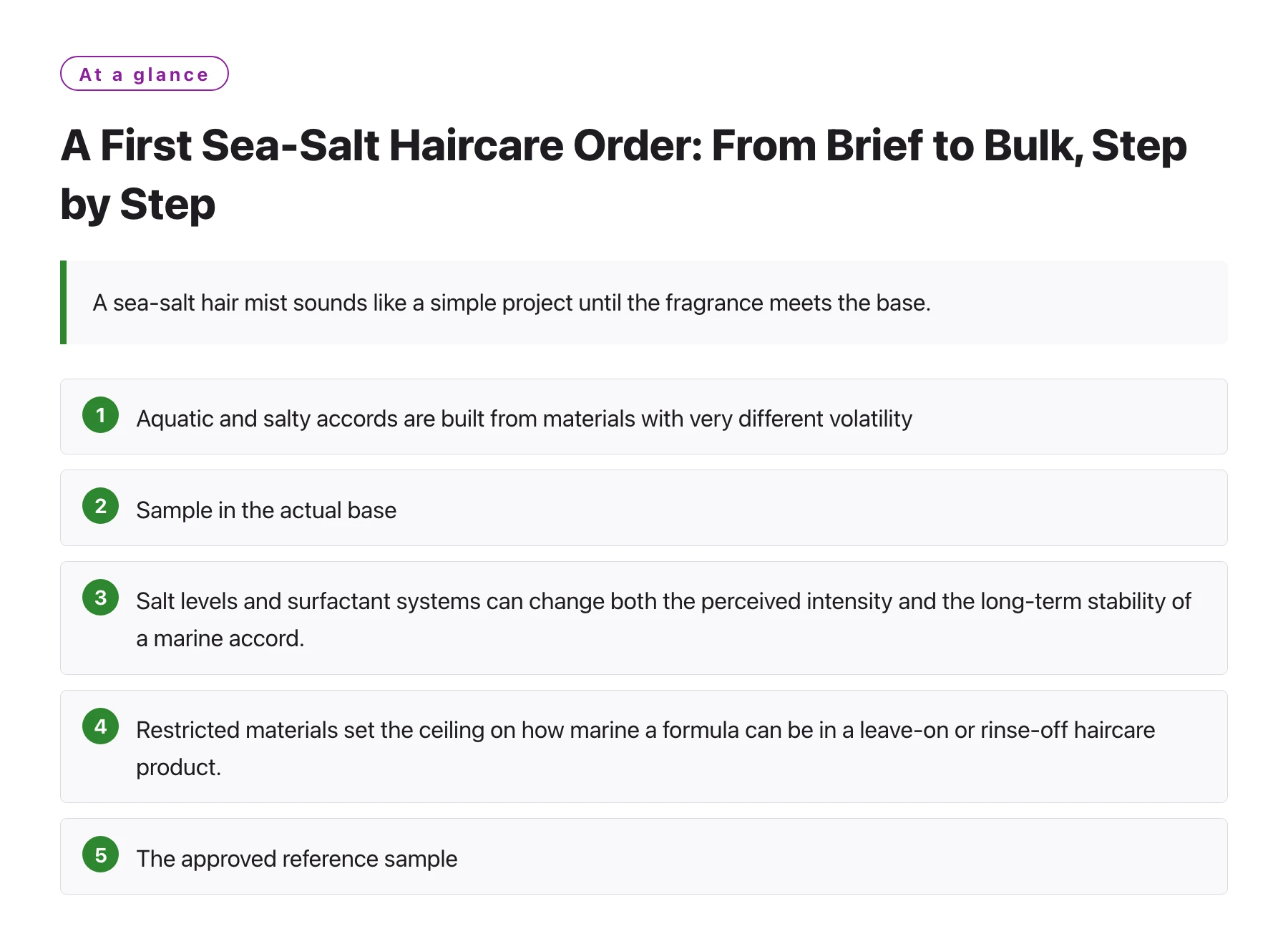
- Aquatic and salty accords are built from materials with very different volatility, so the note reads differently on paper, on skin and in a wet base.
- Sample in the actual base, at the actual dose, before approving anything; a fragrance approved on a blotter is only half-approved.
- Salt levels and surfactant systems can change both the perceived intensity and the long-term stability of a marine accord.
- Restricted materials set the ceiling on how marine a formula can be in a leave-on or rinse-off haircare product.
- The approved reference sample, stored properly, is the only fair benchmark for the bulk run.
Sea salt and aquatic notes sit in an unusual position in perfumery: they are meant to evoke something that has no obvious aroma of its own. The effect is constructed, and the construction depends on how the materials behave in the environment where they are used.
For a haircare line, that environment is a wet, ionic, surfactant-rich base, quite unlike the alcohol solution a fine fragrance was designed around.
This is the order of operations for a first sea-salt haircare project, written as the sequence a product team would actually follow.
The first order, step by step
- Write down what the scent has to do in the productNot a note list, but a behaviour: opening brightness, how it should read on wet hair, whether it should still be noticeable when dry, and what the base smells of on its own.
- Send the base, not just the briefThe formulation to be scented has to reach the perfumer, including the unperfumed base for reference. Sampling without it is guesswork.
- Brief the direction with referencesWhen the brief asks for aquatic notes, water, salt, air, driftwood and skin are different ideas. Give two or three reference products and say which part of each you want and which part you do not.
- Sample at two or three doses in the real baseDose changes the balance as well as the strength. Testing a range shows where the accord stops reading as marine and starts reading as heavy.
- Test the shortlist on hair, not only on skinHair holds and releases fragrance differently from skin, especially in a leave-on mist. Evaluate wet and dry, and after a few hours.
- Approve one reference and scale itSeal the approved sample, record the dose and the base version, and treat that combination as the specification for the bulk run.
Why sea salt and aquatic notes behave the way they do
The aquatic family is a relatively recent addition to the classical note structure, and reference summaries of perfumery describe it as a constructed effect rather than a single material [1]. That matters practically: a marine impression is usually assembled from several materials with quite different volatility, so the top of the accord and the tail of the accord do not age at the same rate.
Material-level descriptions of odour and volatility are published in public databases such as The Good Scents Company, which list individual aroma materials and how they are typically described [2]. A product team does not need to read them all, but it helps to know that a fresh, salty opening is often built on small, fast molecules while the lasting part of the impression comes from heavier materials underneath.
Chemistry-focused publications cover the science of materials and formulation for a general technical audience [3], which is a reasonable place to build vocabulary if the brief has to be discussed with a formulation team rather than a perfumer alone.
The practical consequence is that a marine accord has to be evaluated as a curve, not as a snapshot. Sampling at one moment tells you what the opening is like and very little about what the product will smell like a month after filling.
Testing in the base, not on paper
Blotters and smelling strips are useful for screening directions and almost useless for approving a haircare formula. The base contributes its own odour, its own pH and its own solubilisation behaviour, and the fragrance has to work within all three.
Salt is the obvious variable in a sea-salt line, but it is not the only one. The surfactant system affects how the fragrance is released during washing and how much remains on hair afterwards. Preservatives and pH adjusters can shift the colour of a formula over time. A marine accord built on materials that discolour in an acidic or oxidising environment can turn a clear product cloudy or off-tone.
This is the stage where a dose sweep earns its cost. Asking for three doses in the actual base, held and assessed over an agreed period, produces far more usable information than approving the first sample that smells right on the day. The same discipline applies to the water used: hard water, soft water and treated water can each change how a salty accord reads in use.
What to check at each handoff
| Stage | What is being confirmed | Evidence to keep |
|---|---|---|
| Brief to sampling | That the base version, dose and direction are fixed | The written brief, the base sample reference and the dose range |
| Sampling to shortlist | That each candidate has been assessed in the base | Sample labels with dose, date and base version |
| Shortlist to approval | That the chosen scent performs on hair, wet and dry | Assessment notes and the sealed approved sample |
| Approval to scale-up | That the bulk will be made to the approved combination | Dose, base specification and a retained reference sample |
| Bulk to filling | That the fragrance matches the reference before filling | A comparison record signed by both parties |
Each row is a small document. Together they turn a subjective judgement about a scent into something that can be checked without an argument.
Two mistakes that cost a first order
The first is approving a scent before it has met the base. It feels like progress, and it usually means the first round of bulk production is also the last round of sampling.
The second is changing the base quietly. A formulation tweak after the scent is approved, even one that seems unrelated, can change how the fragrance reads. If the base moves, the approval has to be revisited, and the reference sample is what makes that comparison possible. A partner used to building custom scents and producing them in the same place, such as Xuelei, can usually trace which base version a sample was built against, which shortens exactly this kind of enquiry.
Neither mistake is exotic. Both are avoided by keeping the base version in the record and by treating the sealed sample as a live working document rather than as a souvenir. It also helps to understand about Xuelei how one manufacturer describes its development and manufacturing scope, if only to see what a complete answer looks like when you ask the same questions.
Sources
- Wikipedia: Perfume —— An encyclopaedic overview of perfume covering definitions, history, the note structure of a fragrance and concentration terminology (background reference only).
- The Good Scents Company —— A reference database of aroma materials with odour descriptions, CAS numbers and typical usage information.
- Chemistry World (Royal Society of Chemistry) —— The Royal Society of Chemistry's magazine, covering chemistry research and explanations of everyday materials including aroma compounds.
Frequently asked questions
What is the difference between sea salt and aquatic fragrance?
Aquatic describes a broad fresh, watery family associated with marine and airy effects. Sea salt is a narrower direction within it, leaning on salty, mineral and skin-like facets. The two overlap, which is why a brief should describe the impression rather than only name the family.
Can I approve a sea-salt scent from a blotter sample?
Only for screening. Approval should be based on the fragrance in the actual base, on hair, assessed wet and dry and revisited after a period of storage, because the base and the materials interact.
Does salt in the formula affect the fragrance?
It can affect both how the accord reads and how stable it remains. That is why the salt level and the fragrance should be tested together in the finished base rather than in isolation.
How many sample rounds should a first sea-salt haircare order expect?
Expect more than one. A typical sequence is a direction round, a dose sweep in the base, then a refinement round on the shortlist. Agree how many rounds are included in the price before sampling starts.
What happens if we change the base after approving the scent?
The approval has to be revisited, because a base change can alter the perception and stability of the accord. Keep the reference sample and the base version on record so the comparison is quick rather than a fresh development project.
Considering a coastal celebration, designed with intention?
Our studio accepts a small number of inquiries each season. Begin with a private conversation.
Schedule Your Consultation →